My 13-year-old daughter climbed into the shower fully clothed to hold me up, and that's when I finally asked: is this the rest of my life?
Two weeks later I was sitting in the exam room when Dr. Reynolds pulled up my labs.
"Everything came back normal again. Thyroid, iron, B12. All perfect."
I nodded. Like I always do.
He was already typing when something made me tell him about the shower.
How last week, halfway through washing my hair, my legs just gave out.
How I sat in the tub crying because I couldn't get up.
How my 13-year-old climbed in fully clothed to hold me.
He stopped typing. Looked at me.
"How often do you have crying spells like that?"
"I was crying because I couldn't stand up."
"Mm-hm."
The look on his face told me everything.
"Melissa, your tests are completely normal. I think we need to talk about your mental health."
"And if it's not in my head?"
Silence.
That night I opened my patient portal. Under Assessment he'd written one line:
"Symptoms likely psychosomatic."
In writing. In my permanent record.
Every doctor I see for the rest of my life will read that word before they ever meet me.
I wasn't just sick anymore.
I was never going to be believed again.
I'm 39 years old.
I was an ER nurse for 12 years. Twelve-hour shifts. I never called in sick.
In April 2020, I caught COVID in the ER.
One second I was normal sick.
One hour later, my body was gone.
Not tired. Gone. Like someone had pulled the plug on every cell I had.
Everyone else on my floor bounced back in two weeks.
Six years later, I'm still waiting.
So I did what nurses do. I pushed.
A physical therapist put me on graded exercise. "Just five more minutes each week."
Three weeks in, I couldn't walk to the mailbox.
I tried intermittent fasting. Felt better for two weeks. Then crashed harder than ever.
B12 shots. Magnesium. LDN. A $1,200 "brain retraining" program.
I slept eleven hours a night and woke up feeling like I'd been hit by a truck.
Six years. Fourteen doctors. Every test "normal."
Now I'm trapped at home, unable to do anything.
My life has collapsed.
That night, I couldn't sleep.
Not because of the pain. I'm used to the pain.
Because of what was on the fridge.
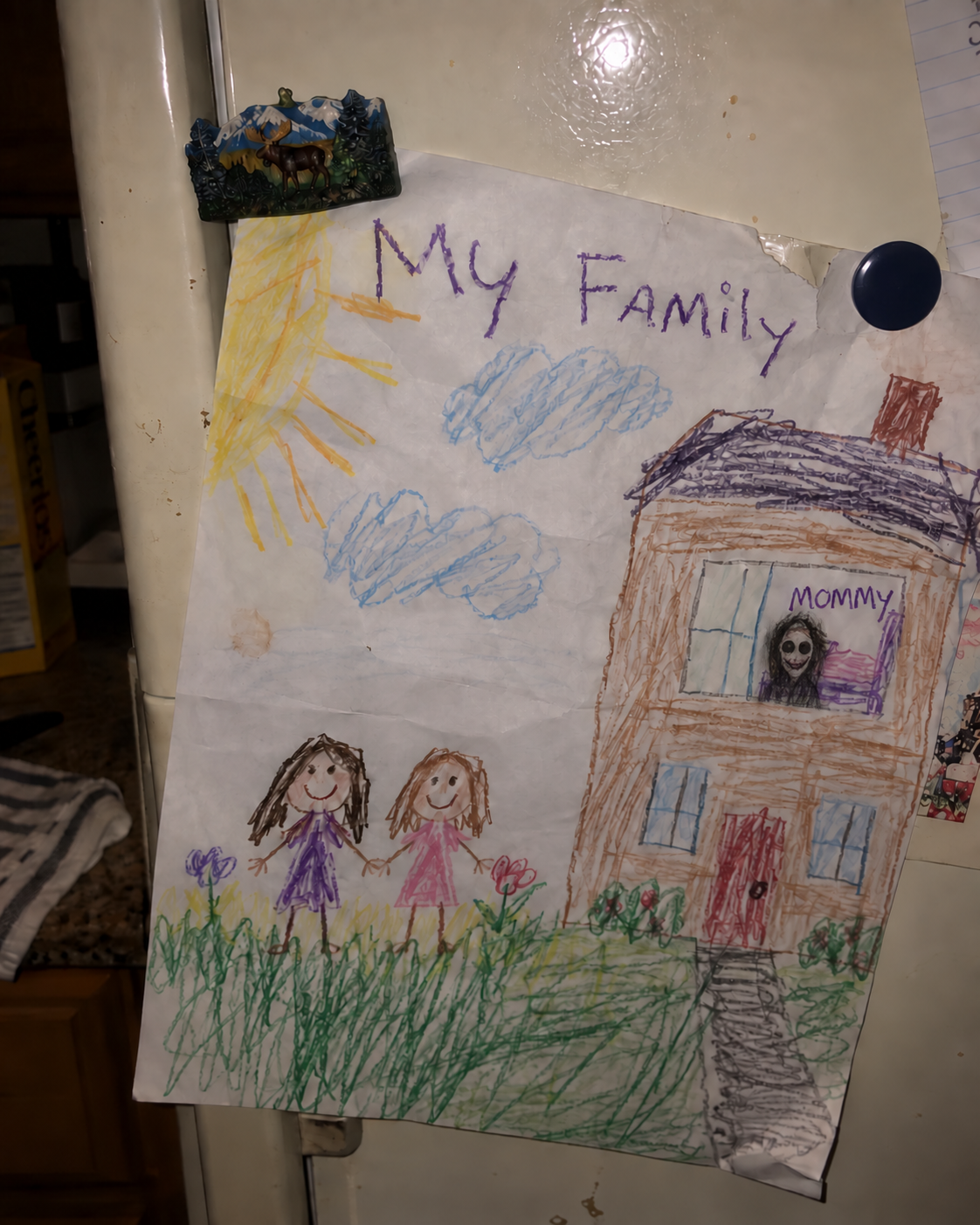
Lily's drawing from school. My Family.
Emma and Lily holding hands in the backyard under a big yellow sun.
And up in the bedroom window, a little stick figure lying in bed. Labeled in purple crayon: MOMMY.
At 2:15 AM I was sitting on the kitchen floor with my symptom journal. Counting.
Days in bed last year: 214.
Days I could shower or make dinner, but not both: 98.
Days I felt like a person: 53.
"Mommy? What are you doing?"
Lily. Seven years old. Standing on the stairs holding her stuffed bunny.
"Just counting, baby."
"Counting what?"
I couldn't tell her the truth. That I was counting how many days I actually got to be her mom.
She sat down on the floor and leaned her head on my arm.
"Mommy, when you're better, can you come outside with us?"
When.
She still thought it was when.
The only person left who believed I'd get better was seven years old.
At 3 AM, after Lily went back to bed, I typed my symptoms into Google. Again.
But this time I didn't search "why am I so tired."
I searched "still exhausted years after covid."
It took me to a forum. Thousands of people who caught a virus and never got their bodies back.
One woman had posted her list:
"'Tired' all the time. Need 11+ hours sleep to feel 'ok-ish.' Brain fog. Muscle pain, especially in calves and back. Can't tolerate exercise. Easily out of breath. Struggle to work half the time."
Those were my symptoms. Word for word.
Someone had replied underneath:
"It's like permanently having the flu, a hangover, and jet lag while being continually electrocuted."
For the first time in six years, somebody knew.
It had a name. Chronic fatigue syndrome.
Not stress. Not anxiety. Not "psychosomatic."
A med student who got sick had written:
"I am 99% sure I would have thought CFS patients were hypochondriacs myself if my symptoms hadn't become so bad."
Twelve years in the ER. I would have written me off too.
Then someone linked a study comparing 20 chronic illnesses.
Chronic fatigue syndrome came in dead last.
Quality of life: worse than cancer.
Here's what nobody tells you:
When the virus hit, every cell in my body went into lockdown. Doors shut. Energy production cut to almost nothing. Survival mode.
That's normal. It's how your body protects itself.
But mine never got the all-clear.
Six years later, my cells still think they're under attack.
That's why my tests were "normal." Nothing was broken. Everything was locked.
And every time I pushed through, my body read it as another attack. The lockdown got tighter.
One comment I must have read ten times:
"I did graded exercise and it's the biggest regret of my life. It made me so much permanently worse so quickly."
Translation: every "push through" was making me sicker.
I stayed on that forum until the sun came up.
And everyone who was still stuck had tried what I'd tried.
One woman tried intermittent fasting. "It makes you feel better, but only temporarily… ruined my life."
Another was on LDN for six weeks. "All I experienced was constant fatigue."
Another had been sick for 14 years and stopped trying altogether. "I just don't have it in me."
Every one of them had tried to force more energy out of a body that was still on lockdown.
I didn't need a boost.
I needed my body to stop betraying me.
That's when someone posted a study out of Denmark.
They'd been studying 207 women with chronic fatigue syndrome. Women just like me.
Half of them took regular CoQ10 every day for eight weeks.
Nothing changed. Same crashes. Same fog. Same bed.
The other half took something else.
And eight weeks later, they had less fatigue. Less brain fog. Better sleep. Their lives back.
It was called Cell-Matched CoQ10.
I'd already tried regular CoQ10. It did nothing.
Now I knew why.
Regular CoQ10 is like sending supply trucks to a city on lockdown. They pull up to the checkpoint and get turned away.
Cell-Matched is made differently.
Each dose of CoQ10 is wrapped in a tiny shell made from the same fats your cell walls are made of.
So when it arrives, your cells don't see a stranger at the gate.
They see one of their own.
Pushing through tries to force the doors open. It only makes the lockdown tighter.
This tells your body it's finally safe to open them.
I started on a Monday. Half dose, because I react to everything.
Didn't change anything else. Same rest. Same routine.
Week one: Nothing. Crashed after a ten-minute phone call, same as always.
Week two: Read Lily a whole chapter of her bedtime book. The next night, I remembered where we left off.
Could be a fluke.
Week four: Cooked dinner. A real one. Then I showered. Same day.
I started paying attention.
Week five: Drove Lily to school. Walked her to the door. Came home and didn't go back to bed.
Week seven: Got my hair cut at a salon. First time in three years. Wore real jeans out of the house.
Week eight: More good days in two months than I'd had all last year.
Week nine: Woke up and didn't do the math. Didn't check my body before my feet hit the floor. Just got up.
Week ten: Emma asked if we could go get ice cream. Right then. No planning.
I said yes.
For the first time in six years, my body didn't punish me for living.
My appointment with Dr. Reynolds was last week.
He pulled up my symptom journal and his eyebrows went up.
"These are a lot better. The behavioral health referral must be helping."
"I never went," I said.
He looked at me.
"I stopped forcing the doors open."
"Last year I had 53 good days. I've had 61 in the last two months."
Silence.
"What changed?"
I told him about the forum. The study out of Denmark. Cell-Matched CoQ10.
He pulled it up on his computer.
Read for maybe two minutes.
Then he did something I never expected.
He opened my chart and deleted one word.
Psychosomatic.
"I'm so sorry, Melissa," he said. "I wish I could've spared you the pain this has caused you."
"I want to write a letter. For your family. Anyone who's doubted you. So they know you were never making this up."
I couldn't talk. I just nodded.
I never thought this day would come.
It's been four months now.
I'm not cured. I still have bad days. And I'd be suspicious of anyone who told you otherwise.
But here's what really changed:
Last Friday I took a long, hot shower.
Washed my hair. Conditioned it. Stood the whole time.
Emma knocked on the door. "Mom? You okay in there?"
"I'm okay, baby."
When I came downstairs, Lily ran up and grabbed my face with both hands.
"Mommy, it's like you're a different person!"
But I'm not.
For six years, the person I missed the most was myself.
She's back.
Last week a new drawing went up on the fridge.
Same backyard. Same big yellow sun.
This time, I'm in it.
I'm not a doctor. I can't tell you what to take.
But I can tell you what I found at 3 AM when I couldn't sleep.
There's a system that was never built to believe us.
And there's research, a study of 207 women just like me, showing there's another way.
The brand is Resova. They're one of the few that wraps every dose of CoQ10 in the same fats your cell walls are made of.
You won't hear about this from your doctor.
Not because anyone's hiding it.
Because more than 9 in 10 people with chronic fatigue syndrome have never even been diagnosed.
Only we know what it's like to not be believed by the world.
I can't tell you what to do with this information.
But six months ago, my 7-year-old asked me when I'd be better.
I finally have an answer.
And I'm never going back to that bedroom window.